
STUDIO
Designing Birth Registration for Rights Awareness
A Legal Design Case Study from Milan
submitted by Lorenzo Zorzi
Executive summary
Birth registration may appear to be a routine administrative step. In practice, it is one of the earliest legal encounters between a person and the State. Recording a birth formally establishes essential facts about a child’s identity and can be crucial to documenting filiation and accessing public services and protections. Its consequences are therefore much broader than the completion of a form.
This article presents a legal design vademecum on birth registration, developed by Design Rights for the Municipality of Milan and published in April 2026. The term vademecum, from the Latin “vade mecum” (“go with me”), traditionally describes a practical reference guide that accompanies its reader. In this project, the term refers to an accessible guide through complex legal and administrative procedures, particularly where uncertainty about parental recognition and children’s rights makes orientation difficult. The guide was designed for families, municipal staff and civic organisations and addresses children born outside marriage or abroad, as well as children of same-sex parent families.
The vademecum was not conceived as a simplified legal leaflet. It was designed as a public legal interface: a tool through which people can understand which situation applies to them, what administrative path they need to follow, which rights and responsibilities are involved, and where the law remains incomplete or dependent on case law.
The project combined legal analysis, plain language, information architecture, visual structuring and stakeholder consultation. It translated a complex and evolving legal framework into a document organised around users’ questions, decision points and recognition paths. In doing so, it framed clarity not as a stylistic improvement, but as a condition for legal agency and rights awareness.
Because the vademecum was published recently, this article does not claim conclusive empirical impact. Instead, it presents the project as a design case and outlines the evaluation agenda that should follow: measuring whether citizens and stakeholders can find relevant information more easily, whether municipal staff can communicate procedures more consistently, and whether families navigating legally vulnerable situations experience greater orientation.
The project originated from a dialogue between Design Rights and the Municipality of Milan’s Department of Civic Services on how legal design could improve access to public information and awareness of rights. The discussion involved the possibility of making administrative communication more useful to citizens, rather than simply reproducing the applicable legal provisions. Birth registration emerged as a particularly meaningful subject because it combines everyday procedures with consequential questions of legal identity and parenthood.
This matters because birth registration is not only an administrative formality. It is the act through which the existence of a person is formally recognised by the State. The birth certificate records essential information about the child, establishes the relationship of filiation and connects the child to a wider system of rights and responsibilities. For parents, it determines who is legally recognised and who exercises parental responsibility. For the child, it is connected to identity, citizenship, access to services, healthcare, education, inheritance and family relationships.
The problem becomes more acute when the legal situation does not fit the implicit “standard” often assumed by administrative communication. Parents may be unmarried. A child may be born abroad. A child may be born within a same-sex parent family. The birth certificate may need to be formed in Italy or transcribed from a foreign act. The recognition of one or both parents may depend on the place of birth, the method of conception, the content of the foreign act, public order limits, or recent constitutional and supreme court decisions.
In these cases, the difficulty is not only that the law is complex. The difficulty is that the law is experienced through fragments: a municipal webpage, a legal source, a court decision, a front-desk answer, a form, a conversation with an association, or advice from a lawyer. Families often need to understand not only what the law says, but what it means for their own administrative path.
This was not an abstract assumption. In the Italian municipal context, citizens can usually find general information on how to request the transcription of a foreign birth certificate. What they often cannot find is an explanation of what happens when that foreign act concerns a family configuration that does not fit the standard administrative template. For example, the case of a child born abroad to two fathers through surrogacy requires the reader to understand not only the transcription procedure, but also the distinction between biological and intended parenthood, the limits of public order, the prohibition of surrogacy in Italy, and the possible role of adoption in particular cases. Without a designed information structure, these elements remain scattered across legal sources, administrative practice and specialist knowledge.
A limited comparative review undertaken later, during the preparation of this article rather than as part of the original design research, examined publicly available information on the websites of Milan, Rome, Naples, Bologna, Turin and Florence. General guidance on transcribing foreign birth certificates was comparatively easy to locate, whereas explicit guidance on sensitive cases involving same-sex parent families, especially children born abroad to two fathers through surrogacy, was less readily identifiable. This observation concerns only the public-facing materials found in that sample: it does not establish that other municipalities provide no guidance through other channels.
The design challenge for Milan was therefore to connect the legal framework with questions that families actually need answered. Beyond explaining a birth registration procedure, the document needed to clarify the implications for filiation, parental responsibility and the available recognition paths, while remaining candid about legal limits and uncertainty. Birth registration illustrates a broader access-to-justice concern: people need understandable information before uncertainty develops into exclusion or a dispute.
The project asked: how can a public administration communicate birth registration in a way that is legally accurate, understandable for non-experts, inclusive of different family configurations and honest about the limits of the legal framework?
The design question
The design question guiding the project can be summarised as follows:
How can the Municipality of Milan explain birth registration so that families, civic organisations and municipal staff can understand ordinary procedures, rights-sensitive cases and evolving legal scenarios without losing legal precision?
This question generated four practical goals.
First, the vademecum had to explain the basic legal function of the birth certificate: what it is, what it contains, why it matters, and how it differs from related documents such as extracts and full copies.
Second, it had to clarify the ordinary administrative path: who must declare a birth, where the declaration can be made, within which deadlines, and what happens in case of delay.
Third, it had to connect birth registration to rights and responsibilities: the child’s rights, the parents’ rights and duties, filiation and parental responsibility.
Fourth, it had to address complex family configurations, especially same-sex parent families, in a way that was accessible, legally careful and useful in practice.
This meant that the final document had to serve multiple audiences at once. It had to be clear enough for citizens, precise enough for legal and administrative stakeholders, and structured enough to support consistent communication by municipal offices.
The project combined legal analysis, co-creation, information architecture, plain language and visual structuring. These components were connected rather than sequentially isolated: legal requirements shaped the visual design, while stakeholder perspectives helped test whether the information could serve its intended audiences.
Legal analysis
The first phase was a reconstruction of the legal and administrative framework.
The team analysed the rules governing birth registration, the function of civil status records, the relationship between birth registration and filiation, and the distinction between children born in Italy and abroad. The work also focused on the legal position of children born to unmarried parents and same-sex parent families.
This phase was not a background research exercise. It was already part of the design process. Before information could be made clear, it had to be separated into different layers: stable rules, procedural requirements, practical explanations, rights implications, case law developments and unresolved issues.
In particular, the team had to distinguish between what could be stated as an administrative rule and what had to be presented as a legally sensitive situation. This distinction was essential in relation to medically assisted reproduction, surrogacy, recognition of the intended parent and transcription of foreign birth certificates.
A central design constraint was to make legally complex scenarios understandable without presenting conditional outcomes as universal rules. Recognition may depend on the place of birth, the method of conception, the family configuration and applicable legislation and case law. The information architecture therefore needed to distinguish scenarios clearly while retaining legal qualifications and references. The comparative table and the separate explanations for children with two mothers and two fathers were responses to that constraint: they help readers orient themselves without suggesting that every family follows the same legal path.
Co-creation: connecting institutional, administrative and lived perspectives
Co-creation was a substantive part of the project rather than a final endorsement of an already completed document. It brought together people responsible for institutional direction, the officials who apply the procedures, organisations concerned with the rights of same-sex parent families, and parents who might rely on the guidance.
Two working sessions involved the Department of Civic Services and representatives of the Mayor’s Office. Interviews with operational officials from the Department provided a direct view of the administrative procedures that the guide needed to explain. Two further joint sessions brought together the Department and associations working to protect the rights of same-sex parent families. These shared discussions made it possible to consider institutional and civic perspectives together when addressing legally sensitive situations.
A further session involved couples of parents representing different family configurations and was used to validate the document’s content. Across these activities, the project connected four perspectives: institutional priorities, administrative practice, civic knowledge and the experience of parents. Their involvement informed the development and review of a public-facing guide intended for more than one audience.
Information architecture
The third component was information architecture.
A traditional administrative document often follows the order of legal sources or institutional competences. That structure may be logical for experts, but it is rarely how users search for information. Families do not start from the legislation. They start from their situation.
For this reason, the vademecum was organised around use. It begins with orientation: what the document contains and how to read it. It then explains the basic concepts: what a birth certificate is, what the birth declaration is, and why registration matters. Only after this foundation does it move into more specific scenarios: children born abroad, rights and duties deriving from registration, children of unmarried parents, and children of same-sex parent families.
This order was deliberate. The document first creates a shared vocabulary, then introduces procedural paths, then addresses sensitive cases. In design terms, it uses progressive disclosure: it does not force the reader to confront every legal complexity at once.
The vademecum also uses a layered structure. Some information is written as general explanation. Some is presented as a point of attention. Some is connected to legal references. Some is shown visually through tables, icons and recognition paths. This allows different users to access the level of detail they need.
Plain language
The fourth component was plain language.
The task was not to remove legal meaning, but to make legal meaning accessible. Terms such as birth certificate, civil status, filiation, parental responsibility, recognition, transcription, intended parent and biological parent had to be explained without being emptied of their legal relevance.
Plain language was therefore applied as a method of translation, not simplification. The project avoided both extremes: copying legal language directly, which would reproduce opacity, and using overly informal language, which could create imprecision in a rights-sensitive context.
The guiding principle was: users should not need legal training to understand the document, but legal professionals should still recognise the accuracy of its content.
Visual structuring
The fifth component was visual structuring.
The vademecum uses hierarchy, icons, tables, visual cues and path-based layouts to help readers navigate different scenarios. This is especially visible in the section on same-sex parent families, where the document distinguishes between PMA and GPA, Italy and foreign countries, different family configurations, and different recognition outcomes.
The visual system was not decorative. It served three functions.
First, it made comparison possible. Users could see how different situations are treated differently.
Second, it reduced the cognitive load of reading dense legal information.
Third, it made visible where recognition is possible, limited or not available.
In a field where legal outcomes depend on combinations of factors, visual design became a tool for legal reasoning.
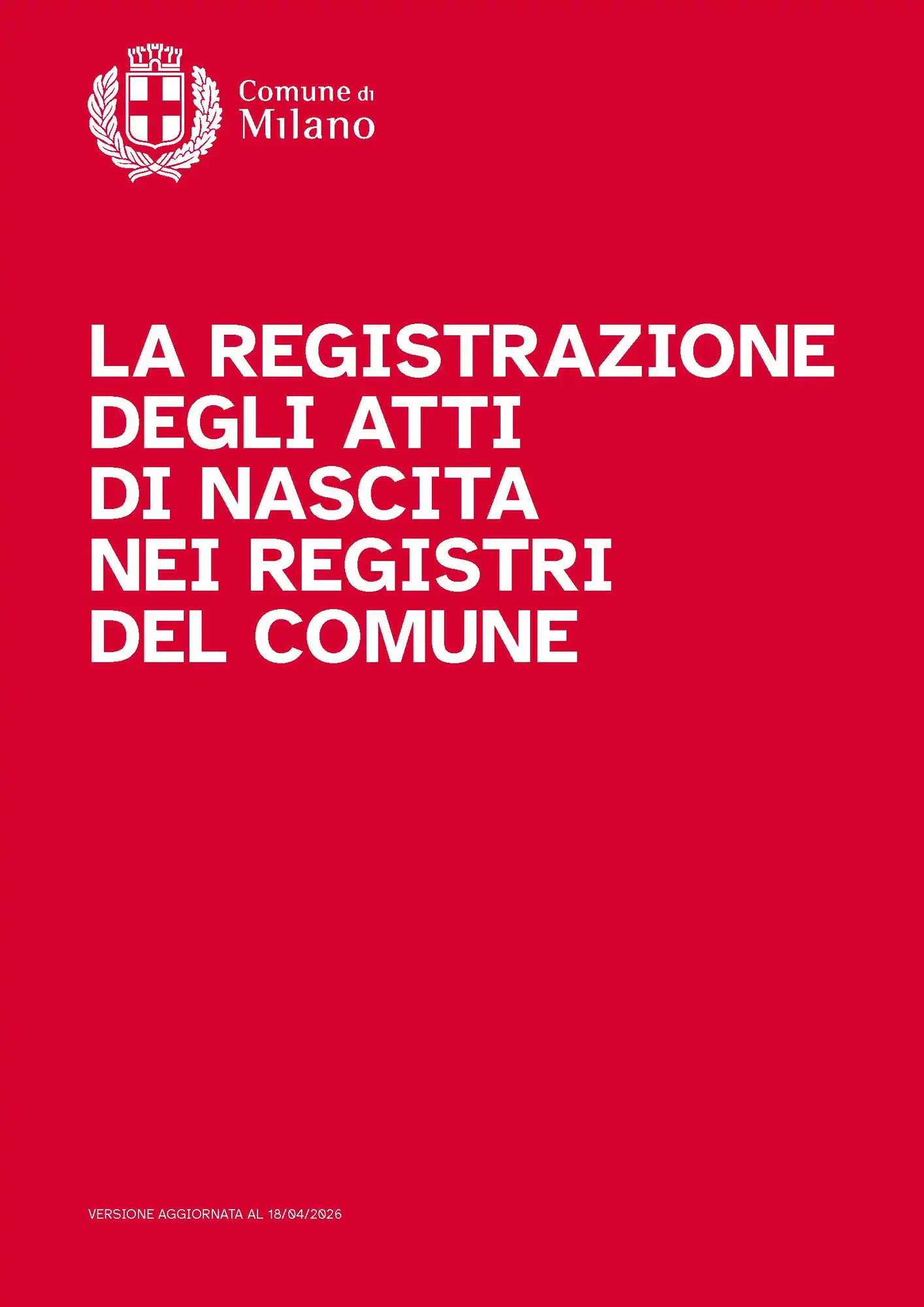
The final output was a ten-page vademecum titled “La registrazione degli atti di nascita nei registri del Comune”.
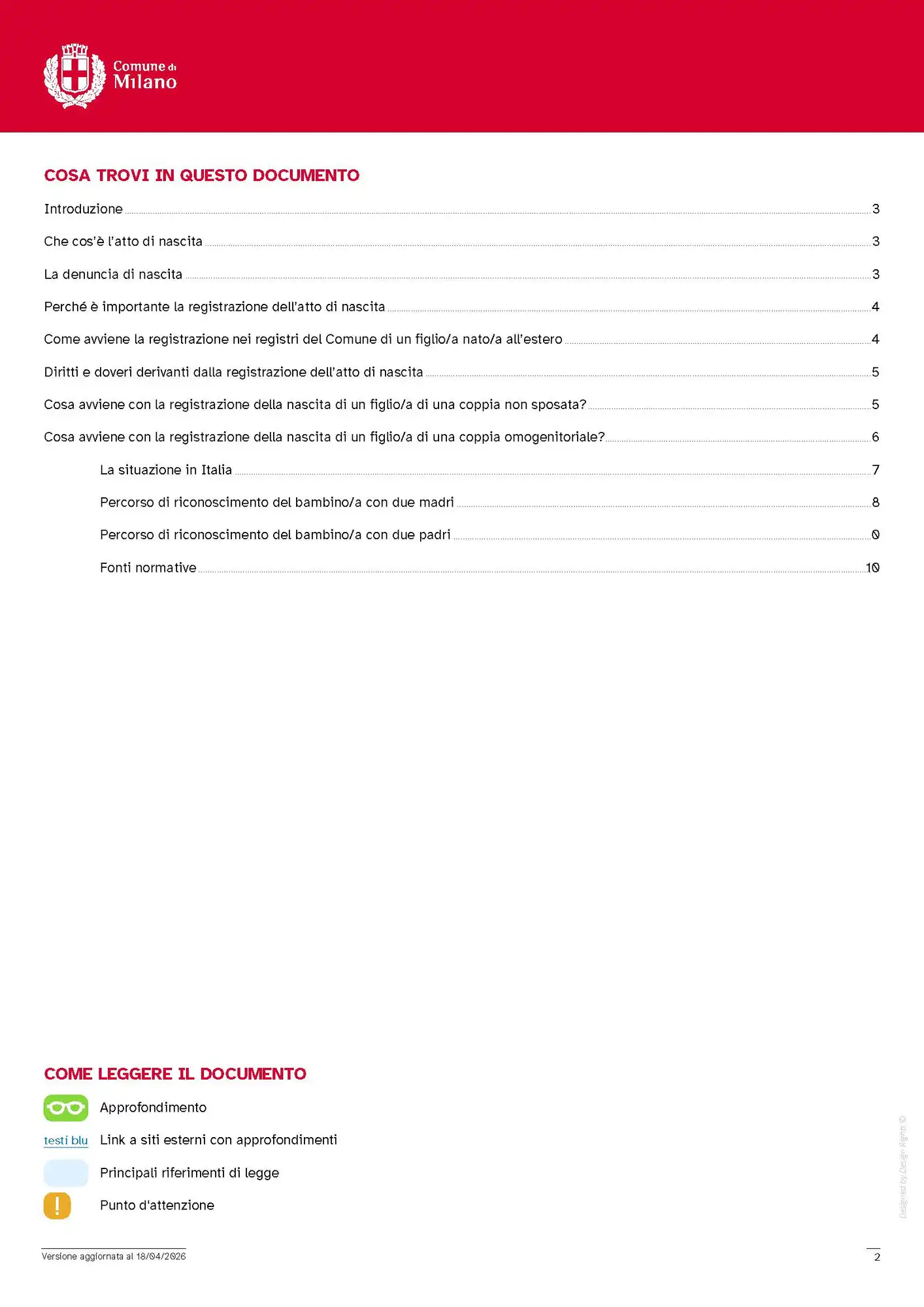
The document opens with a clear table of contents and a short guide on how to read it. This may seem ordinary, but it is a crucial access feature. It tells readers that the document is not meant to be read like a statute. It is meant to be navigated.
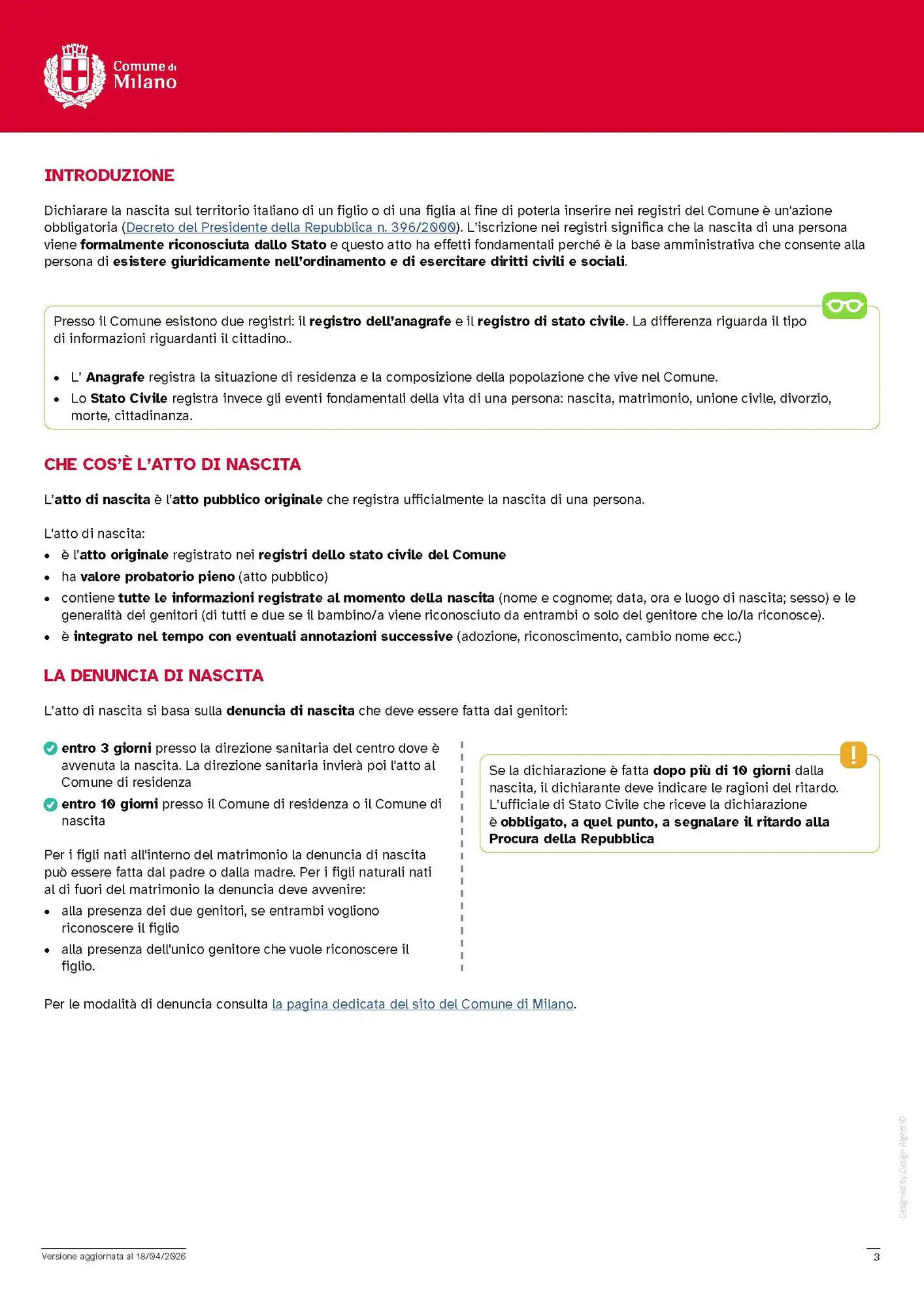
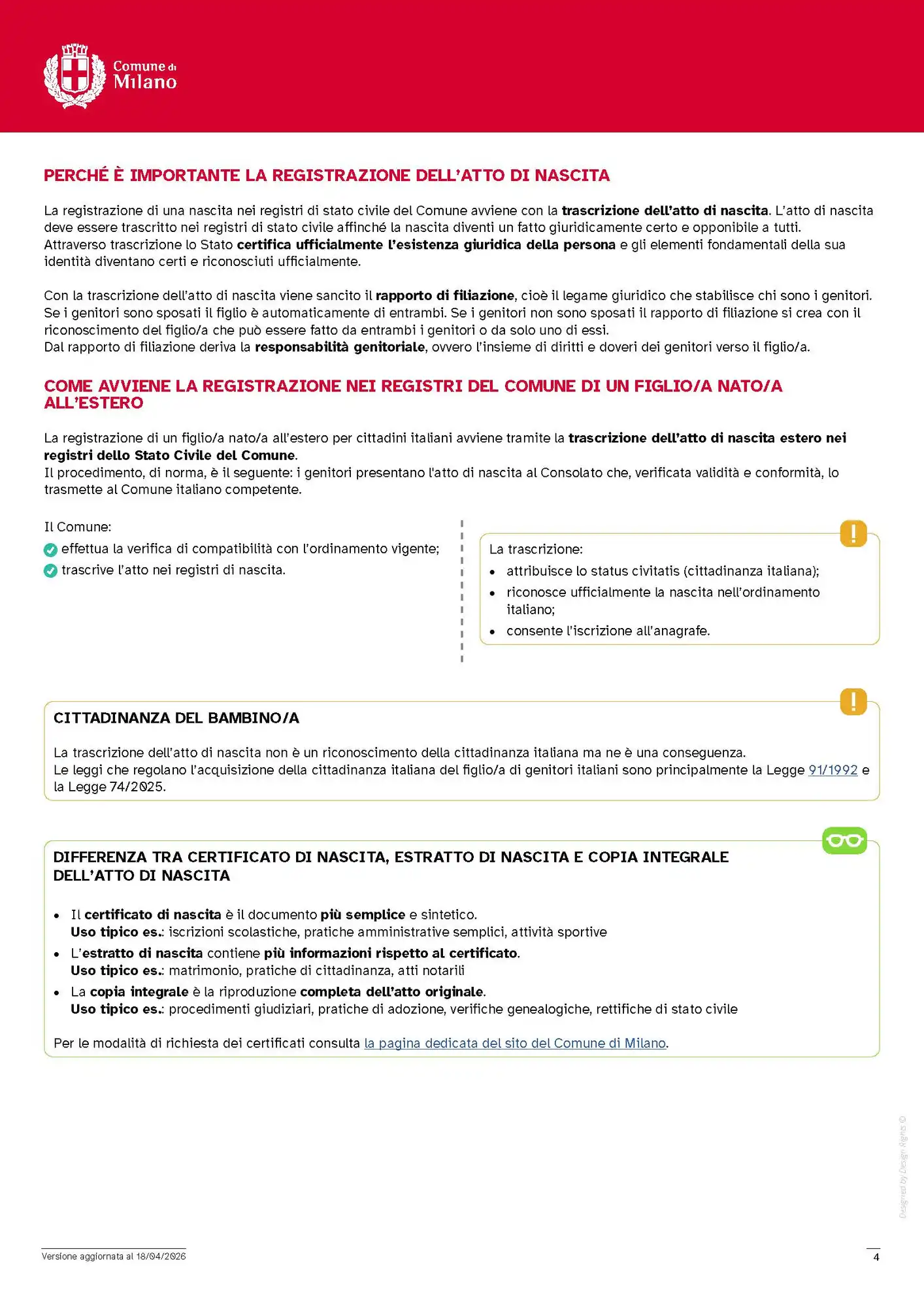
The first substantive section explains that birth registration is the act through which a person’s birth is formally recognised by the State. It clarifies the difference between registry records and civil status records, then explains the birth certificate and the birth declaration.
The document then explains why birth registration matters. It links registration to legal identity, filiation and parental responsibility. It also distinguishes between different types of documents: birth certificate, birth extract and full copy of the birth act. This is a practical choice: citizens often encounter these terms in administrative life, but may not understand their different uses.
The vademecum then addresses children born abroad. Here the document explains the transcription of foreign birth acts, the role of consulates, the compatibility check performed by the municipality, and the relationship with citizenship and registration.
A dedicated section explains the rights and duties deriving from birth registration. For parents, it describes representation, management of the child’s interests, and educational and health decisions, together with duties such as maintenance, education and moral assistance. For the child, it connects birth registration to name, citizenship, access to healthcare, education, maintenance, moral assistance and inheritance.
Another section addresses children of unmarried parents. It explains that Italian law no longer distinguishes between legitimate and natural children, while clarifying that filiation is not automatic in the same way as for married parents. Recognition and pre-recognition are explained as practical legal steps.
The most sensitive section concerns children of same-sex parent families. The vademecum explains that, in Italy, PMA and GPA are not legally accessible to same-sex couples. It then maps the possible recognition scenarios, distinguishing method of conception, country of birth, type of couple and legal outcome.
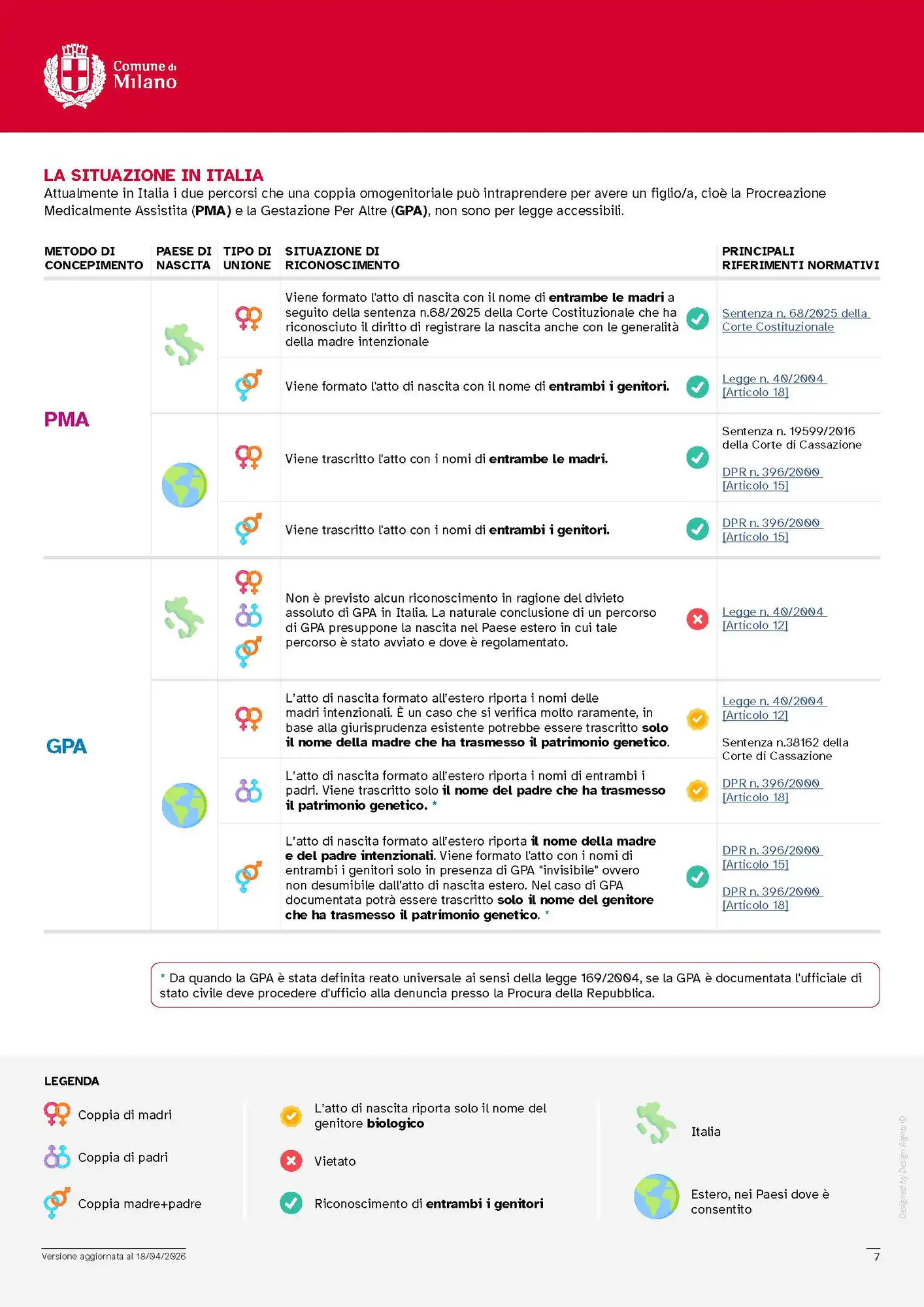
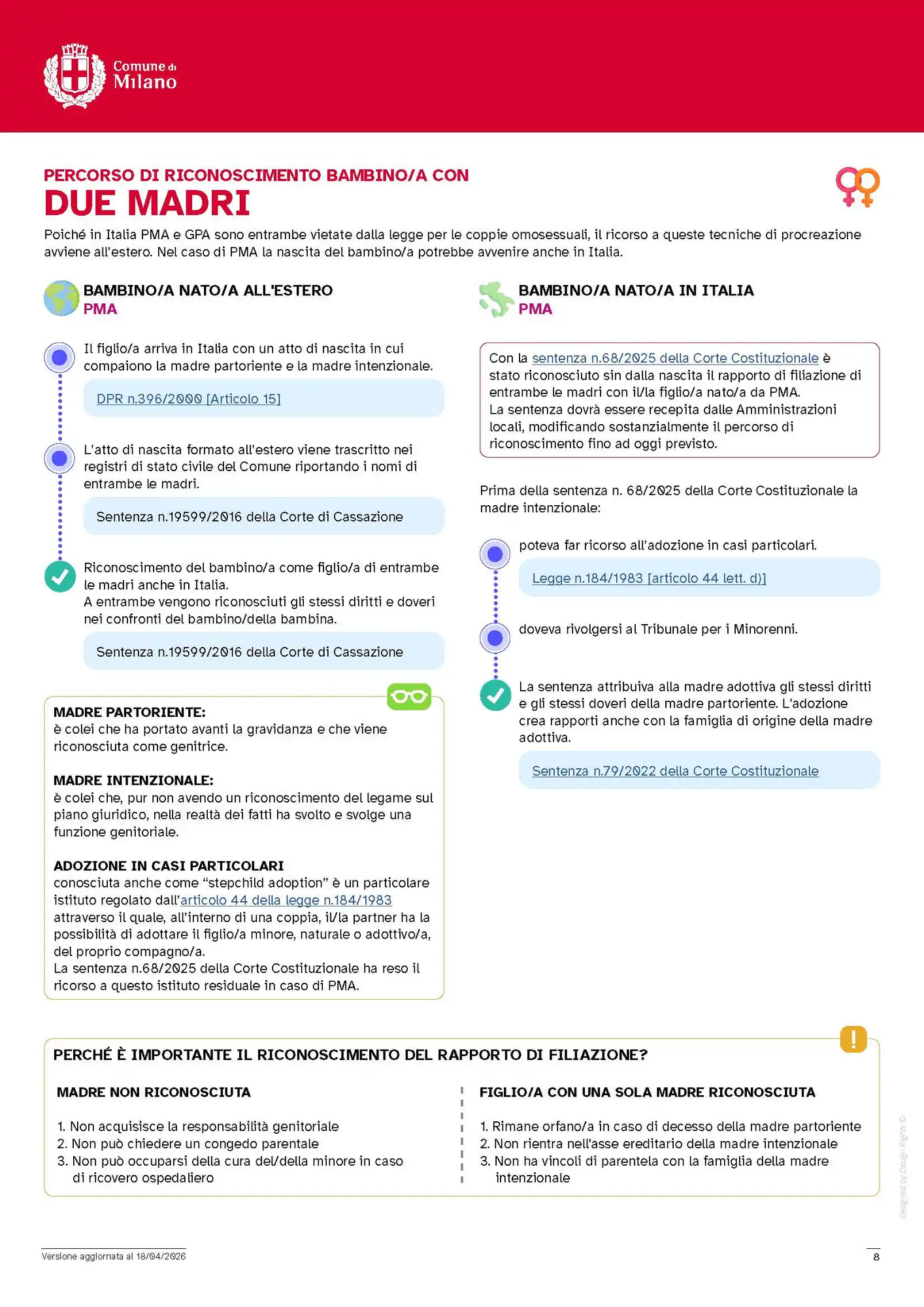
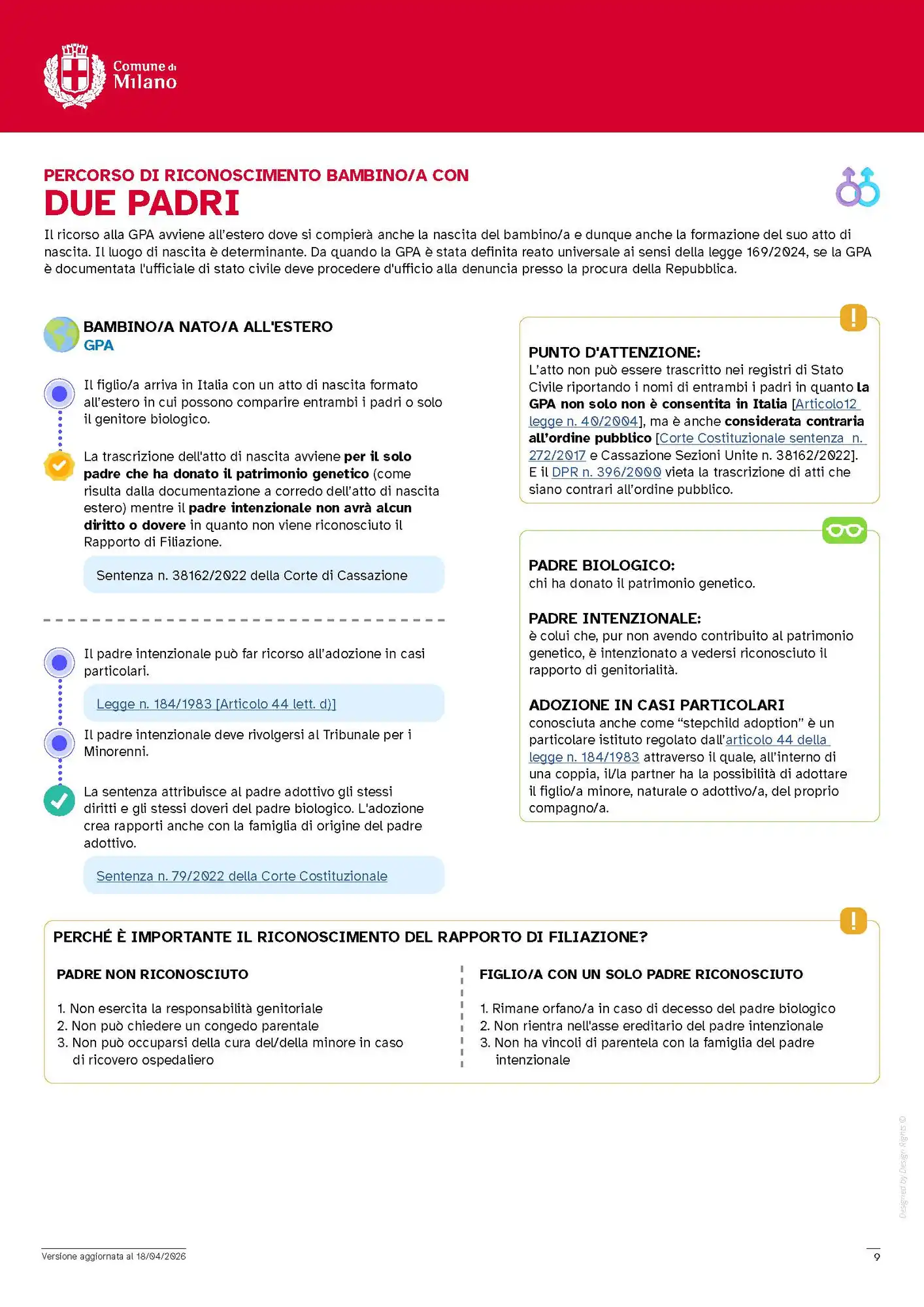
The central visual device is a comparative table that combines method of conception, place of birth, family configuration, recognition outcome and the principal legal references. Separate pages then explain the legal recognition paths for children with two mothers and children with two fathers. The table offers orientation across scenarios; the more detailed pages provide context, qualifications and consequences that cannot responsibly be compressed into a single diagram.
The section on children with two fathers is a clear example of this approach. Instead of limiting the explanation to the formal possibility of transcribing a foreign birth certificate, the vademecum reconstructs the actual recognition path. It explains that, where the child is born abroad through surrogacy, the birth act may include both fathers or only the biological father, but the transcription in Italy is limited to the father who transmitted the genetic heritage. It then clarifies that the intended father does not automatically acquire rights or duties because the relationship of filiation is not recognised through transcription, and that the available path is adoption in particular cases before the Juvenile Court.
This is precisely the kind of information that is difficult to obtain from ordinary municipal webpages on foreign birth certificate transcription. The legal design value of the vademecum lies in connecting the administrative act to its consequences for the family relationship.
The vademecum does not try to hide these differences. It presents them clearly, because clarity also means allowing people to see where equality is still incomplete.
What we learned
The project generated several lessons that may be useful for other public administrations and legal design practitioners.
Public legal documents are interfaces
A vademecum is not a neutral container. It shapes how people understand their position, how they interact with institutions and whether they feel capable of acting. In birth registration, this is especially important because the document concerns a child’s legal identity and the recognition of family relationships.
If the interface is unclear, the consequences are not merely communicative. People may lose time, misunderstand rights, seek unnecessary legal assistance or experience the administration as inaccessible.
Clarity begins before writing
One of the strongest lessons is that plain language is not the first step. Before rewriting, the team had to reconstruct the legal framework, identify scenarios, separate levels of certainty and decide the structure of the document.
Many public documents are difficult to understand not because sentences are too long, but because the underlying architecture is unclear. They fail to answer users’ questions in the order in which those questions arise.
Legal design therefore begins with structure.
Participation connects legal accuracy with real-life needs
One lesson was the value of examining the same administrative and legal framework from different perspectives. Two institutional sessions, interviews with operational staff, two joint sessions with civic organisations, and a content-validation session with parents created opportunities for these perspectives to inform the same public document.
The joint sessions were particularly significant because the Municipality and organisations supporting same-sex parent families could discuss a sensitive area of law in a shared setting. The parents’ validation session added the perspective of intended readers. Together, these activities connected legal accuracy and administrative requirements with the questions arising in family life.
The case suggests that participation in public-sector legal design should extend beyond either expert legal review or consultation with intended readers alone. Its value lies in bringing different kinds of knowledge into the creation and review of a public-facing legal artefact.
Legal uncertainty should be designed, not hidden
Some legal design projects focus on simplification. This case shows that simplification is not always the right objective. When the law is incomplete or evolving, excessive simplification can mislead.
The better objective is navigability. Users should understand what is clear, what is uncertain, which path is available and where further assistance may be needed.
This is especially important in fields shaped by constitutional and supreme court decisions rather than comprehensive legislation.
Inclusion requires explicit design choices
Administrative writing often assumes a standard user. In birth registration, that implicit standard can exclude families whose configuration does not match traditional assumptions.
The vademecum was designed to make non-standard situations visible within the official information environment of the municipality. This does not solve legal inequality, but it reduces informational inequality. It tells families that their questions are part of the institutional map.
Limits and impact agenda
The vademecum was published recently, so the project does not yet offer robust empirical evidence of impact. It would be premature to claim measured reductions in front-desk requests, improved comprehension scores or increased trust.
However, the project defines a clear impact agenda.
At the user level, future evaluation should assess whether families can find the information relevant to their situation more easily, whether they better understand the difference between ordinary and complex registration paths, and whether the document reduces uncertainty before contacting municipal offices.
At the organisational level, evaluation should examine whether municipal staff use the vademecum as a shared reference, whether answers become more consistent across offices, and whether recurring questions decrease.
At the civic level, evaluation should involve organisations working with same-sex parent families and other stakeholders to understand whether the document actually supports orientation in sensitive cases.
Possible indicators include time-to-answer for common questions, recurring question patterns at front desks, qualitative feedback from families and associations, internal feedback from municipal staff, and comprehension testing on selected sections of the vademecum.
This caution is important. Legal design cannot fill legislative gaps. It cannot replace judicial protection. It cannot solve structural discrimination by making a document easier to read. But it can make existing rights and procedures more visible. It can expose where the law remains unclear. And it can help public institutions communicate in a way that is more transparent, accountable and usable.
The Milan vademecum shows how legal design can help public administrations rethink the relationship between legal information and citizen experience.
Birth registration is not only a formality. It is a threshold moment in which a person enters the legal order and a family relationship becomes visible to the State. Designing information around this moment means designing access to rights before conflict arises.
The project also shows that legal design in public administration should not be reduced to visual communication. Its deeper contribution lies in combining legal accuracy, user orientation, stakeholder knowledge, plain language and information architecture. The result is not simply a clearer document. It is a public legal interface that helps people understand where they stand and what they can do.
For public institutions, this means moving from publishing rules to designing legal orientation. A guide, a form, a webpage or a vademecum is never only a document. It is a point of contact between people and power. Designing it with care is therefore not a marginal improvement. It is part of what democratic administration owes to the people it serves.
Project team and credits
The Milan vademecum case was developed by Design Rights with the Municipality of Milan, with the contribution of civic organisations and relevant municipal stakeholders. The project team consisted of Lorenzo Zorzi and Stefano Cardini.
AI disclosure
A generative AI assistant (ChatGPT) was used to support drafting, restructuring and language editing of this article, including comparison of author-provided materials and alignment with the STUDIO editorial format. The author supplied the project documentation, defined the scope and verified editorial choices. All factual descriptions, legal references and statements concerning the design process and its results remain subject to the author’s final verification against project records and current institutional information. The author retains responsibility for accuracy, permissions, confidentiality, copyright and the final text.
Download this use case now.
Call for Submissions!
Submit your Legal Design story until June 30, 2026.
Next Issue of the LDJ
We are receiving submissions for Vol. 3 of the Journal!

Do you want to share your Legal Design Story with the world?
Everyone can submit a use case for review by our expert team.
Here’s how.
How does it work?
We are looking for different kinds of use cases out of different phases of a legal design process.
This part of the Journal will showcase the best work and developments in legal design. This can be in the form of text, digital artifacts, reports, visualisations or any other media that we can distribute in a digital journal format. Text submissions can be between 1,000 and 5,000 words and are reviewed by our Studio editorial team.
What kind of practical use cases can I submit?
We are looking for Prototypes or implemented solutions of legal design use cases.
Your submission should consist the following:
Your submission should consist the following:
- Challenge: Describe the problem you had to solve
- Approach: Describe the selected design process and phases you went through in order to solve the challenge. Please insert also a section of the impact that your concept will bring or brought.
- Solution: Show us the solution you developed. Not only with words but with images.
Make sure you do have permission and the rights to share your project an materials (such as images and use case stories etc.)
Why is there a review process?
Our goal is to show high quality legal design cases for others to learn from.
How does the review process look like and how do we select use cases for publication ?
We are looking for Prototypes or implemented solutions that will be reviewed by the following criteria:
- Aesthetics
- Depth of concept (Why, What, How)
- Process steps you selected
- Impact
Do you want to share your Legal Design Story with the world?
What are the requirements for submission?
Please find a list of requirements and tips here.
Why publish with us?
Reputation
The editorial teams are comprised of many of the leading legal design academics and practitioners from around the world.
Diamond open access
We are a diamond open-access journal, digital and completely free to readers, authors and their institutions. We charge no processing fees for authors or institutions. The journal uses a Creative Commons BY 4.0 licence.
Rigour and quality
We are using double blind peer review for Articles and editorial review for the Studio. Articles are hosted on Scholastica which is optimised for search and integration with academic indices, Google Scholar etc.
Your Studio Editorial Collective
Do you want to see more use cases ? Take a look at the websites of some of our Studio editorial team.


AI Usage & Disclosure Policy
Please take note of our AI Usage & Disclosure Policy***