STUDIO
Can administrative decisions actually work?
A Design Study on Voting Arrangements in Simultaneously Conducted Election
submitted by Outi Nokkonen, Elise Rehula, Anna Sutherland (Design Agency Kolmas Persoona)
Photos: Riina Nousu
Illustrations: Kolmas Persoona Oy
Introduction
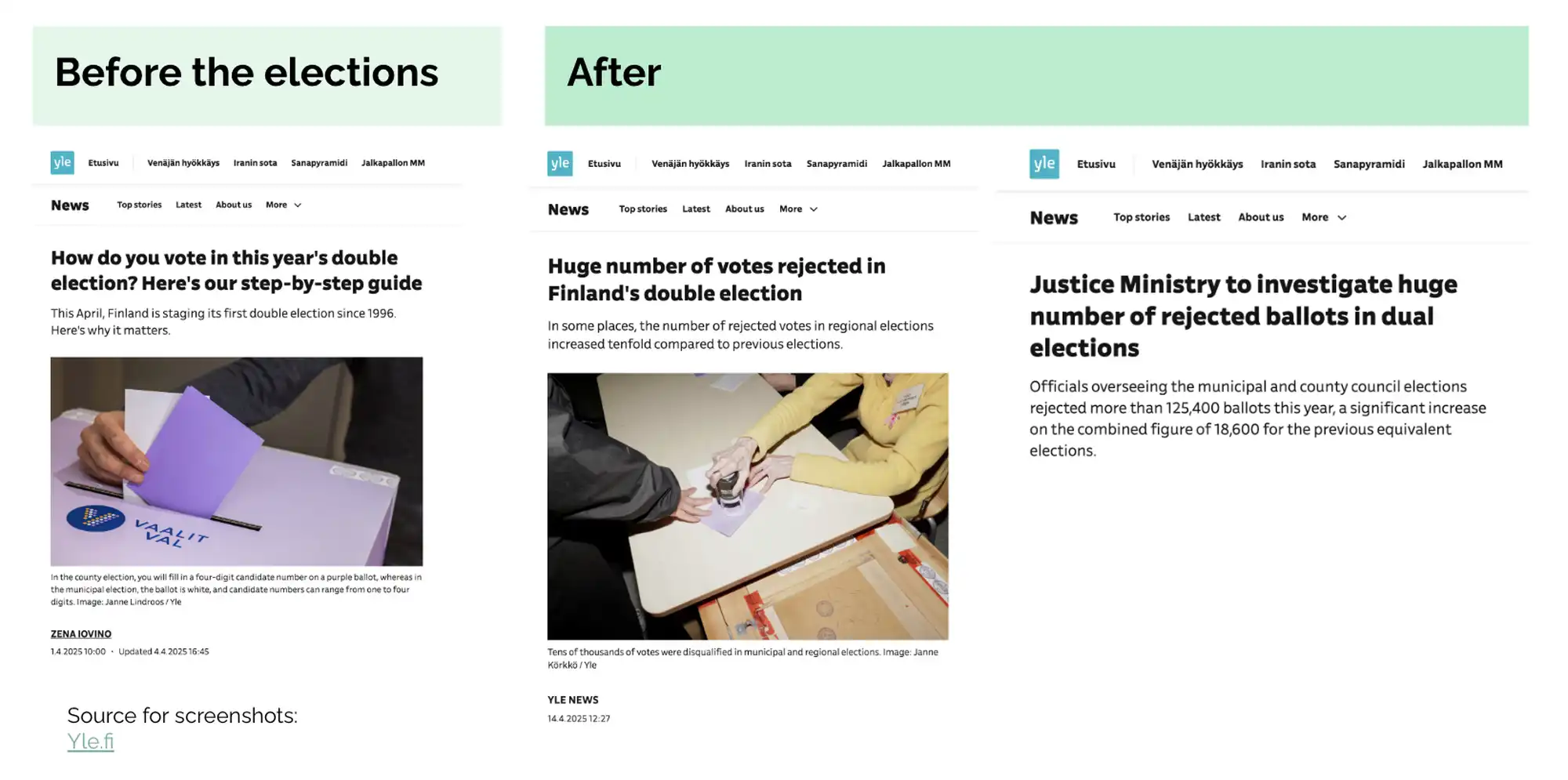
When two elections were held on the same day for the first time in decades, far more ballots were rejected than in a single-election vote — and that prompted the elections team at Finland’s Ministry of Justice to commission its first ever design project on elections.
The double election grew out of a structural change in Finnish government: the creation of the wellbeing services counties, a new layer of public administration with its own elected councils. To avoid holding elections too often, and in the hope that the well-established municipal vote would lift turnout for the new regional one, the two were scheduled together in 2025.
Rejected ballots are normally a marginal phenomenon, hovering around one percent. This time the regional election saw 4.0% (over 80 000 ballots). Voters appeared to be confusing the two elections with each other, and an unfamiliar voting situation left many uncertain about what to do.
The design brief was a practical one: develop concrete proposals to make these simultaneous regional and municipal elections clearer and easier to navigate, with two areas in focus — how polling stations are set up, and how voters are guided and informed.
Our leading question was set from the user’s perspective: how do you make the moment of voting as clear as it can be, and stop a marking error before it happens?
In this article we want to present the details of our design process through two lenses:
- How to find space for design in a very heavily regulated context, such as the elections?
- In this kind of design work, live prototyping is the only choice, even if it feels risky and resource-heavy – so how can it be done?
LENS 1: Finding Space for Design in a Heavily Regulated Context
Election administration is one of the most tightly regulated processes in the public sector, and that is usually where a design conversation stops. Our first move was to reject that conclusion and instead map the terrain to sort the voting journey into what cannot move and what can.
Our starting point is the voter’s holistic experience of elections. In international research this is captured by the concept of voter experience (e.g. James & Garnett, 2023; Schneier & Lehr, 2025): everything a voter perceives, observes and feels at the various stages of the electoral process, from seeking information through the act of voting to the period afterwards. To examine that experience in detail, we applied a service design approach, dissecting it into components and touchpoints from the user’s perspective.
This produced three levels:
- User experience: the level we want to make an impact on – voting needs to be easy and simple, even in two simultaneous elections.
- Frontstage, the level of voting touchpoints: the elements that municipalities and the Ministry of Justice can shape through their concrete actions and choices.
- Backstage, the level of factors that affect the voting process but are slow to change: elements that are not in the hands of any single actor (for example, societal factors and traditions) or are hard to change for other reasons (e.g. legislative matters).
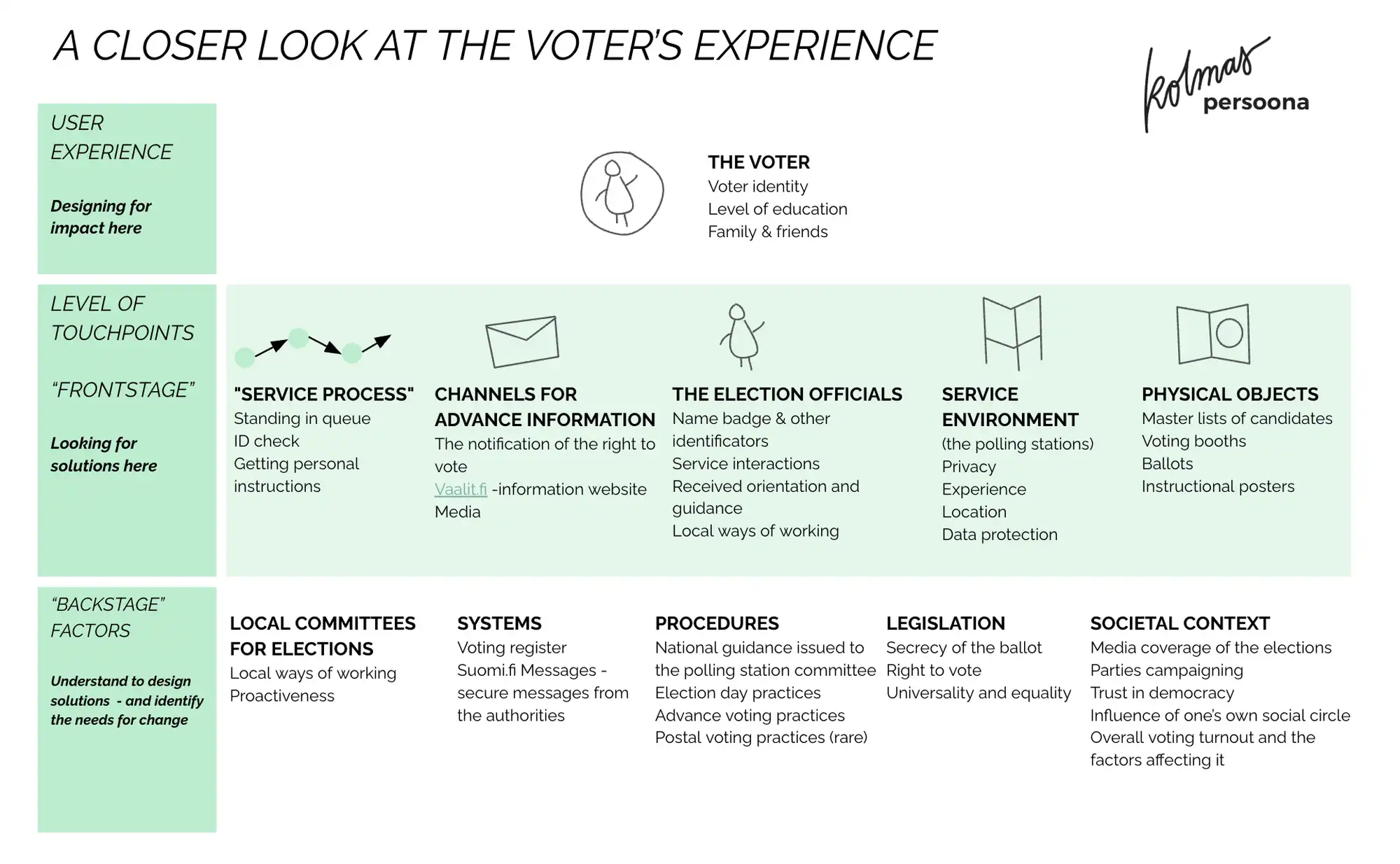
The figure above brings these levels into one picture, illustrating the pieces that make up the overall voter experience. Separating them out located precisely where design could make a difference and grounded the development proposals in voters’ own perspectives. Some background factors fall outside the scope of this study (e.g. the statutory core that no single actor can move), but they still matter, because the voter experience is the sum of its parts to which every piece and encounter contributes.
For legal design in the public sector, the first deliverable is often just this: clarity about where freedom exists. Once you draw the line between what is fixed and what is open to choice or modifications, a process that looked untouchable turns out to have a fair amount of designable surface after all.
James, T. S., & Garnett, H. A. (2023). The voter experience around the world: A human reflexivity approach. Representation, 59(4).
Schneier, B., & Lehr, H. (2025, May 22). The voter experience. Harvard Kennedy School Ash Center for Democratic Governance and Innovation.
LENS 2: Live Prototyping as the Only Choice
A polling-station solution does not get to “fail gracefully”. It has to hold up in a real, crowded, time-pressured environment, used by the whole adult population at once: first-time voters, the hurried, people voting in their second language, people with failing eyesight. A solution that works in a design workshop and collapses in the real setting is not a solution.
The two routes a designer would normally reach for testing are both closed. You cannot run a controlled A/B test during an actual election. Nor can you fall back on voters’ recall. Interviews and surveys alone would not give accurate insight, because a person cannot reliably remember the real moment of voting, with its pace and stress and small uncertainties.
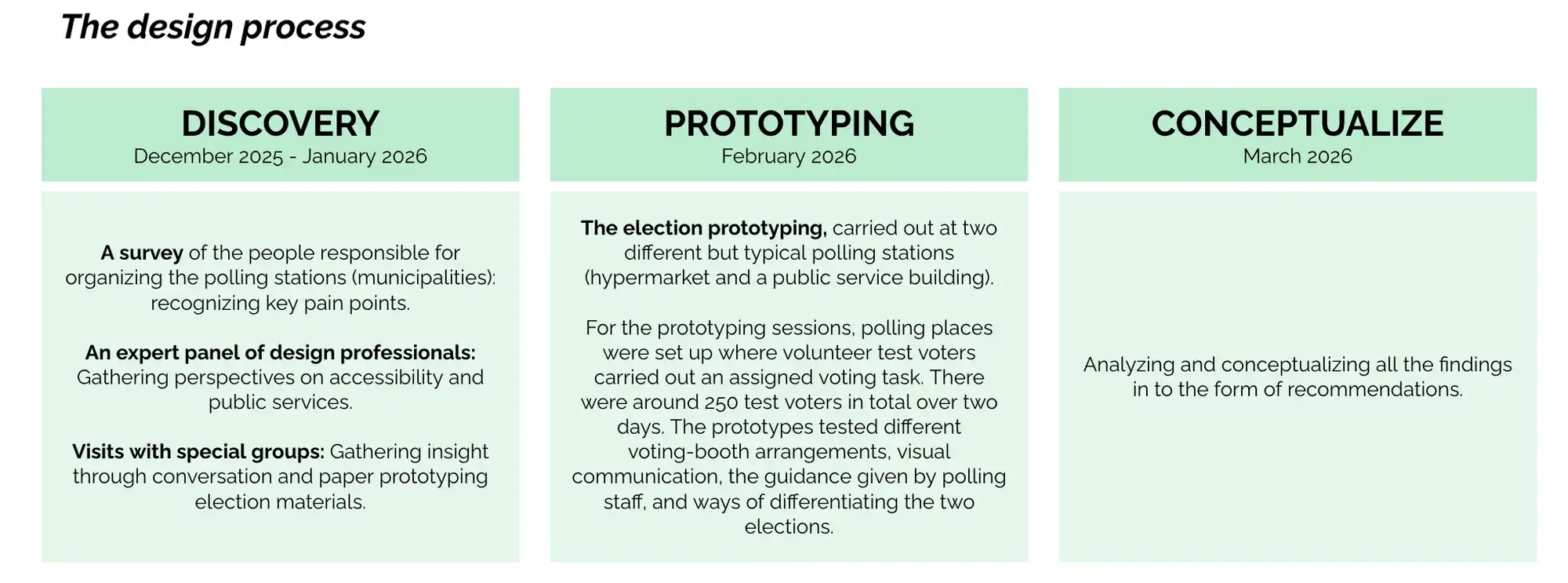
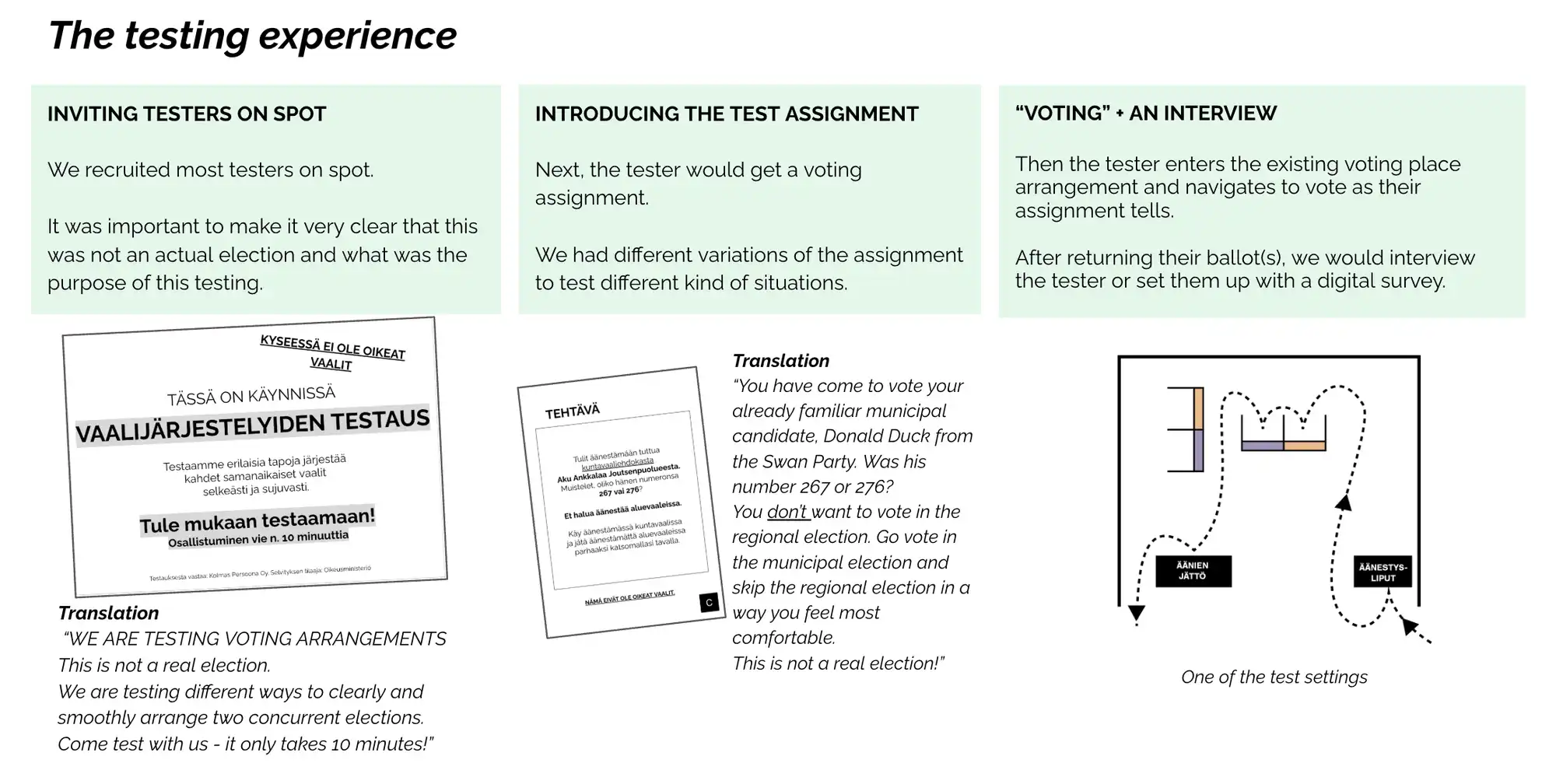
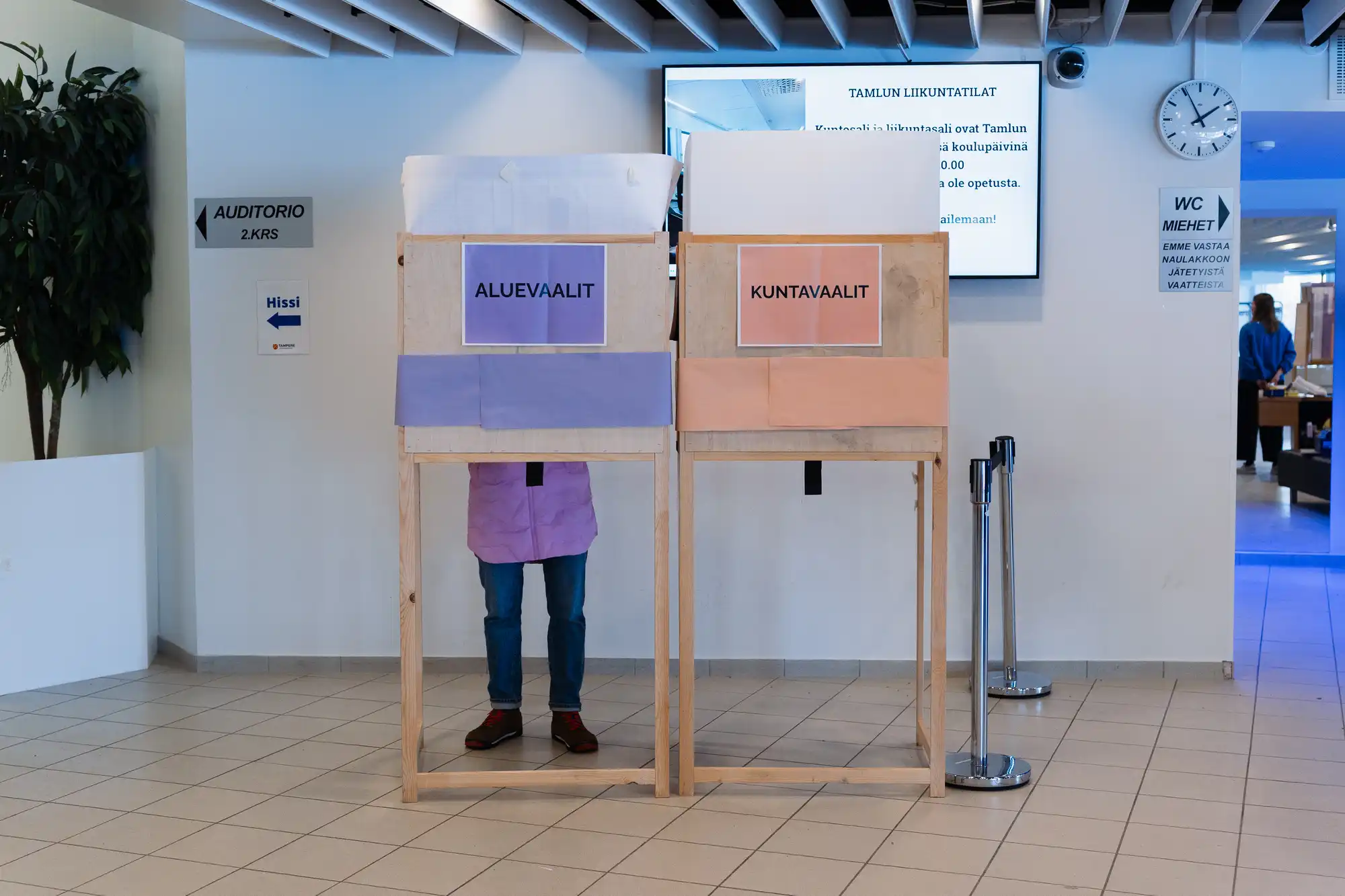
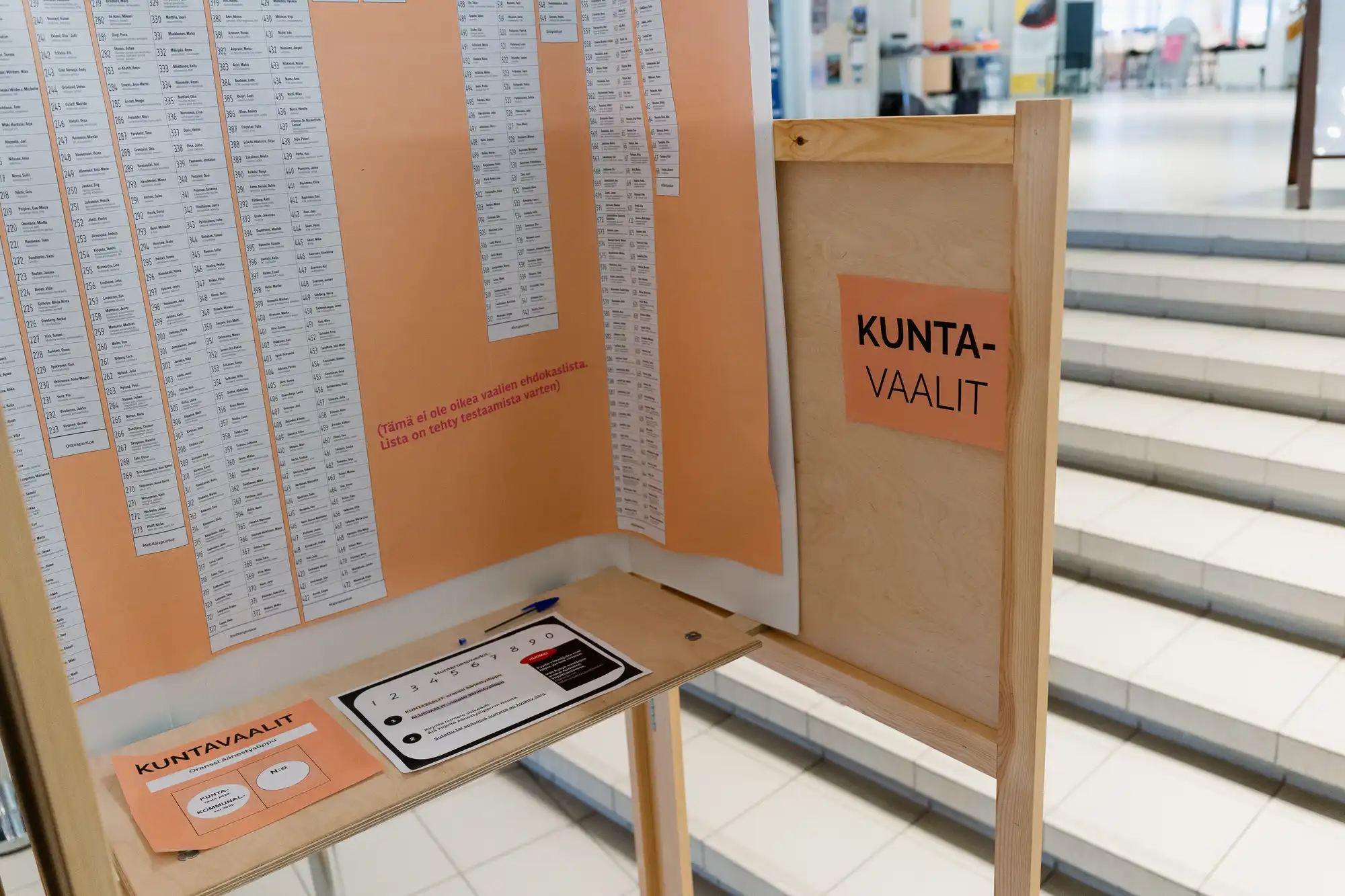
So the design team built the test with true-to-life prototype elections, staged in genuinely public venues (a busy hypermarket and an adult education centre ー both previously used as recurring polling stations). We used actual election artefacts, such as voting booths and privacy shields, and produced prototype materials ourselves (ballots, master lists of candidates, guidance posters, etc). Roughly 250 volunteer test voters (recruited on the spot) ran through complete prototype voting journeys under different arrangement setups, and we observed and measured where confusion and marking errors actually occurred.
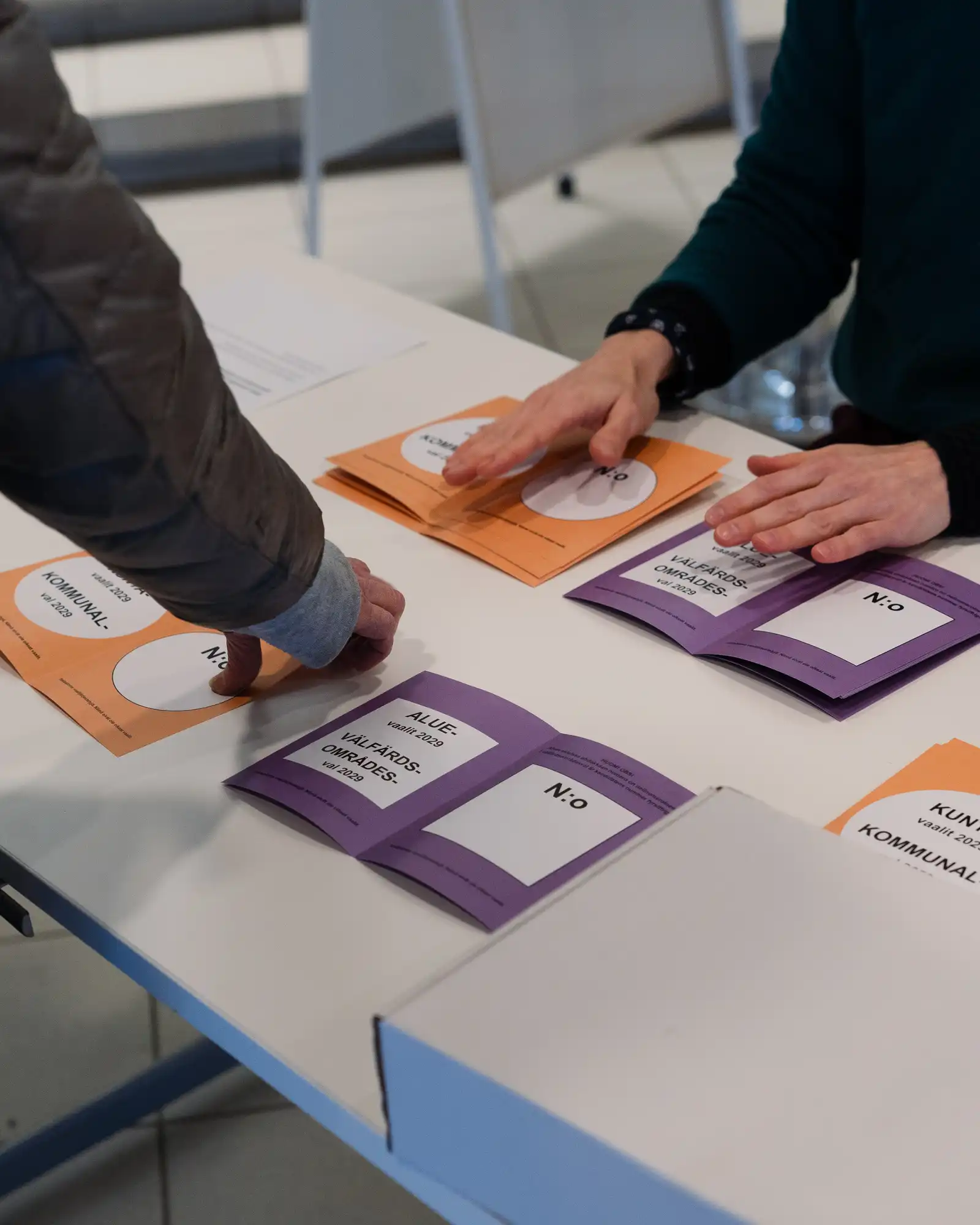
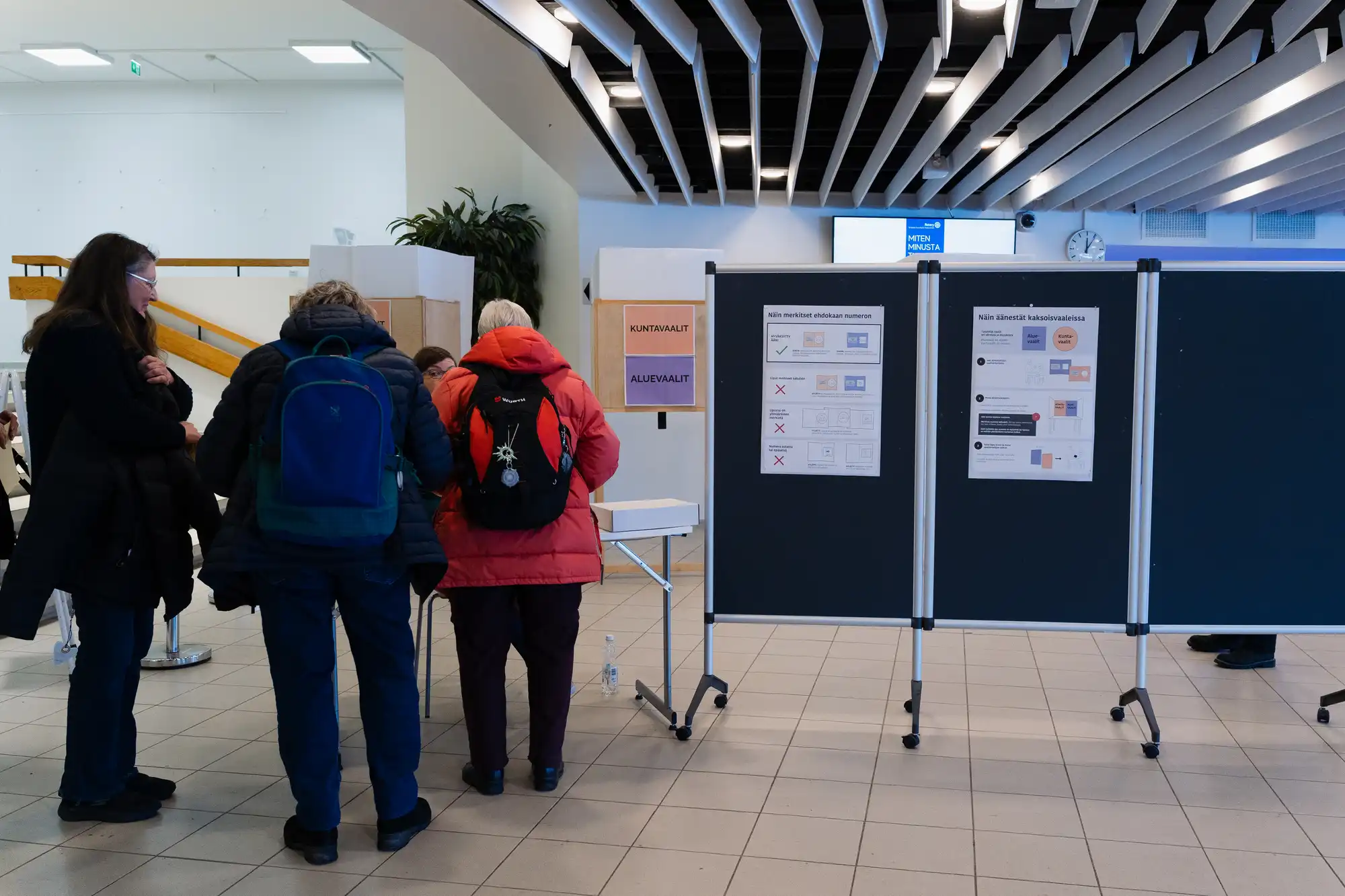
The prototyping was based on discovery phase done first:
- Municipal surveys capturing experiential knowledge from 25 election officials responsible for arranging elections and 50 members of polling staff ー the people who watched voters getting confused in 2025.
- An expert panel on design and accessibility (e.g. professors and researchers from Finnish design universities, public service design experts from major cities and public organisations) helped us to identify principles for designing an accessible voting journey.
- Pre-visits to two groups expected to be hard to recruit as test voters for the prototyping days: a class for immigrants in preparatory education for programmes leading to an upper secondary qualification, and a group of pensioners. Reaching these groups early in the process meant that the live test would also include the populations most exposed to a confusing voting situation.
Building the prototype was a critical part of the method. Because we were after a genuinely true-to-life test, we staged the prototype elections in actual former polling venues and reconstructed different voting arrangements inside them.
In conclusion
The conclusions of the study were published in full on the Ministry of Justice’s website. This was the first time the Finnish Ministry of Justice applied design thinking to voting and democracy ー making the case itself part of the impact: a precedent for treating the voter’s experience as a designable object within election administration.
What comes next
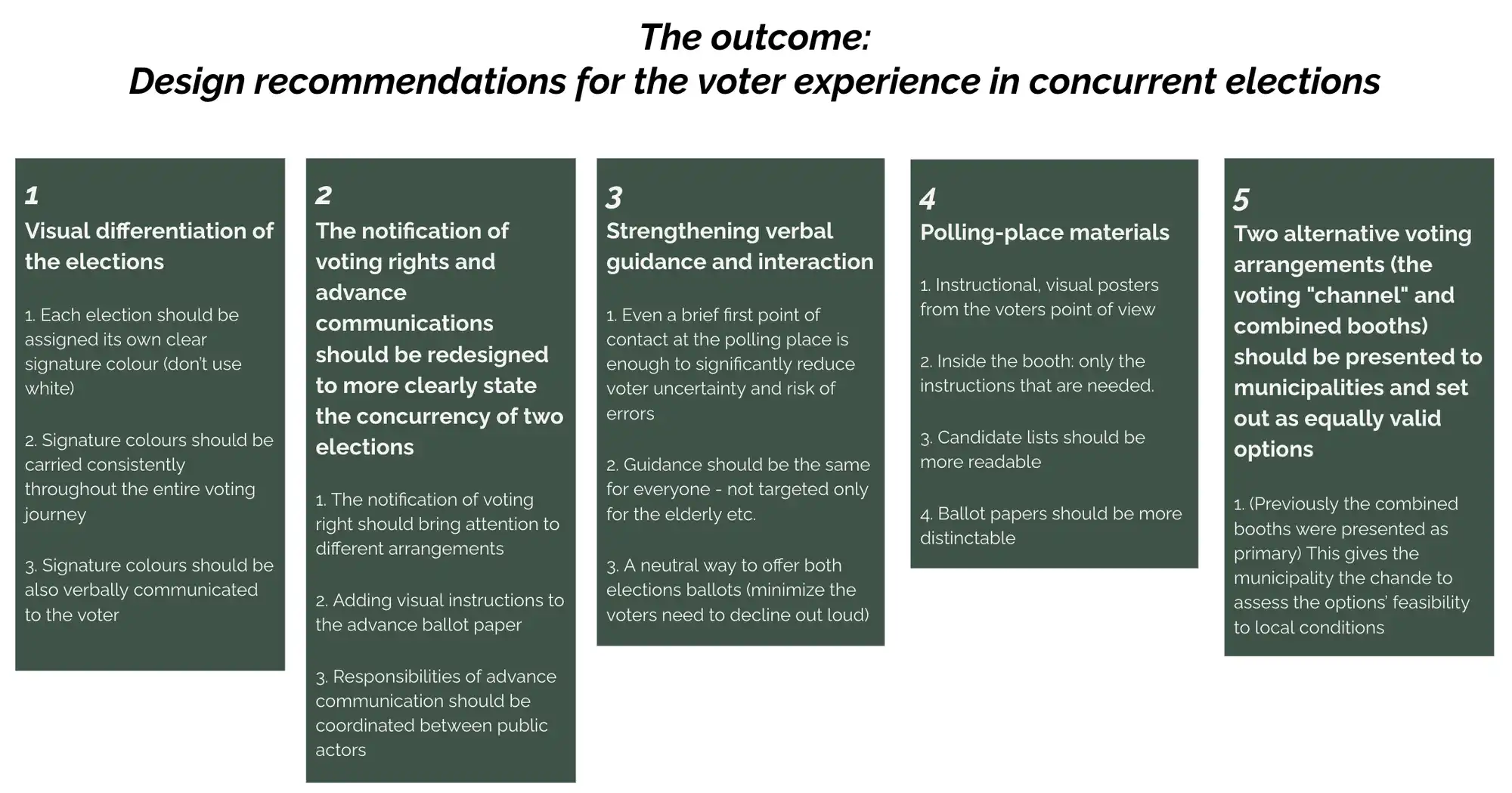
The feedback from the Ministry of Justice’s elections team was positive, and all the five main recommendations the study produced were considered feasible to implement. The recommendations themselves varied in kind. Some validated assumptions the team already held, and here it was valuable to gain evidence and support for those assumptions directly from “users”. Others give the Ministry grounds to reinforce, in future elections, measures already trialled in the 2025 concurrent elections, while a few would require amendments to the Election Act before they can be put into practice. For example, an amendment to allow using two colors (not white) for the ballots is due to be processed later in 2026. It was also significant to confirm that part of the problem stems from factors beyond guidance itself and are issues no amount of clearer instruction can resolve.
Most concretely, the elections team gained support for drafting the next round of election guidance ー the instructions issued to municipalities to help them apply the provisions of the Election Act ー and, in particular, for deciding what to emphasise in it.
Two things surprised us, both positively: how well the creative methods worked, and how the visual form of the final report was received, as opposed to a conventional text-based report.
Download this use case now.
Call for Submissions!
Submit your Legal Design story until June 30, 2026.
Next Issue of the LDJ
We are receiving submissions for Vol. 3 of the Journal!

Do you want to share your Legal Design Story with the world?
Everyone can submit a use case for review by our expert team.
Here’s how.
How does it work?
We are looking for different kinds of use cases out of different phases of a legal design process.
This part of the Journal will showcase the best work and developments in legal design. This can be in the form of text, digital artifacts, reports, visualisations or any other media that we can distribute in a digital journal format. Text submissions can be between 1,000 and 5,000 words and are reviewed by our Studio editorial team.
What kind of practical use cases can I submit?
We are looking for Prototypes or implemented solutions of legal design use cases.
Your submission should consist the following:
Your submission should consist the following:
- Challenge: Describe the problem you had to solve
- Approach: Describe the selected design process and phases you went through in order to solve the challenge. Please insert also a section of the impact that your concept will bring or brought.
- Solution: Show us the solution you developed. Not only with words but with images.
Make sure you do have permission and the rights to share your project an materials (such as images and use case stories etc.)
Why is there a review process?
Our goal is to show high quality legal design cases for others to learn from.
How does the review process look like and how do we select use cases for publication ?
We are looking for Prototypes or implemented solutions that will be reviewed by the following criteria:
- Aesthetics
- Depth of concept (Why, What, How)
- Process steps you selected
- Impact
Do you want to share your Legal Design Story with the world?
What are the requirements for submission?
Please find a list of requirements and tips here.
Why publish with us?
Reputation
The editorial teams are comprised of many of the leading legal design academics and practitioners from around the world.
Diamond open access
We are a diamond open-access journal, digital and completely free to readers, authors and their institutions. We charge no processing fees for authors or institutions. The journal uses a Creative Commons BY 4.0 licence.
Rigour and quality
We are using double blind peer review for Articles and editorial review for the Studio. Articles are hosted on Scholastica which is optimised for search and integration with academic indices, Google Scholar etc.
Your Studio Editorial Collective
Do you want to see more use cases ? Take a look at the websites of some of our Studio editorial team.


AI Usage & Disclosure Policy
Please take note of our AI Usage & Disclosure Policy***